
What Makes a Food Waste Disposer Powerful Enough for Daily Kitchen Use
Anyone who has fed a chicken bone or a wad of celery stalks into a weak disposer knows the sound of trouble: a motor straining, then stalling, then silence. That moment is why shoppers search for powerful food waste disposers instead of settling for whatever came cheapest at the hardware store. Power isn't a vanity metric here. It determines whether your sink handles real dinner cleanup or just rinses plates.
This article breaks down what "powerful" actually means in motor terms, how that power translates into daily usability, and what specs matter when comparing units for a home kitchen.
Why Motor Power Alone Doesn't Tell the Full Story
Wattage gets printed in bold on every product listing, and it's tempting to assume higher numbers always win. But a disposer's effectiveness depends on how that power is delivered, not just how much exists on paper.
A 1200W motor paired with poor torque control can still jam on fibrous scraps like corn husks or onion skins. Conversely, a well-engineered motor at the same wattage, built around brushless DC (BLDC) technology, converts electrical input into shredding force more efficiently than older induction designs. The difference shows up in load RPM, grinding stage count, and how the unit behaves under sudden resistance.
So when evaluating powerful food waste disposers, look past the watt rating alone. Ask how the motor manages variable loads, because that's where kitchens actually live.
BLDC Motors and Why They're Changing the Baseline
Brushless DC motors have been standard in power tools and electric vehicles for years, prized for efficiency and reduced mechanical wear. Food waste disposers are catching up to that same logic.
Unlike brushed induction motors, BLDC units have no physical brushes grinding against a commutator. That means less friction, less heat buildup, and, according to the manufacturer's specifications, a longer practical service life under daily use. A disposer like the PCD-1200TS model from ZAL uses this motor type at 1200W, running at 1500 RPM no-load and up to 3000 RPM under load, according to the manufacturer's technical specifications.
That jump between no-load and load RPM matters more than it sounds. It indicates the motor can ramp up torque dynamically when food waste hits the chamber, rather than running at a flat speed regardless of resistance. For households that regularly dispose of fruit pits, celery, or potato peels, this kind of responsive power delivery reduces stalling.
Anti-Jam Design: Solving the Oldest Disposer Complaint
Ask anyone who has owned a disposer for more than a year what frustrates them most, and jamming tops the list. A single stringy vegetable or a stray spoon can lock the flywheel, forcing a manual reset with an Allen wrench under the sink.
Modern disposers address this with automatic forward and reverse rotation. Instead of grinding in one direction until something gives, the motor reverses briefly when it senses resistance, dislodging the obstruction before continuing. This is listed as a core feature in the PCD-1200TS's design, paired with intelligent grinding control that adjusts speed and shuts the unit down automatically once processing finishes.
The practical value here is simple: fewer trips under the sink with a flashlight, less wasted time, and a disposer that recovers from minor jams without manual intervention.
Two-Stage Grinding: What It Means for Food Breakdown
Grinding chamber design varies across the market, and the stage count is one of the clearer indicators of mechanical sophistication.
A single-stage grinder shreds material once before pushing it toward the drain. A two-stage system passes waste through an initial shredding phase, then a secondary breakdown stage, resulting in finer particles that move through plumbing with less resistance. The PCD-1200TS uses a 2-stage grind system with a 1300ml grinding capacity, which suits typical household meal cleanup volumes without requiring constant emptying mid-cycle.
For buyers comparing models, grinding stage count is worth asking about directly, since manufacturers don't always highlight it the way they do wattage or horsepower equivalents.
Noise Levels: The Spec Everyone Forgets to Check
Power and noise often move together, but they don't have to. Older induction-motor disposers tend to run loud, partly because of mechanical vibration from brush contact and partly due to looser tolerances in the grinding chamber.
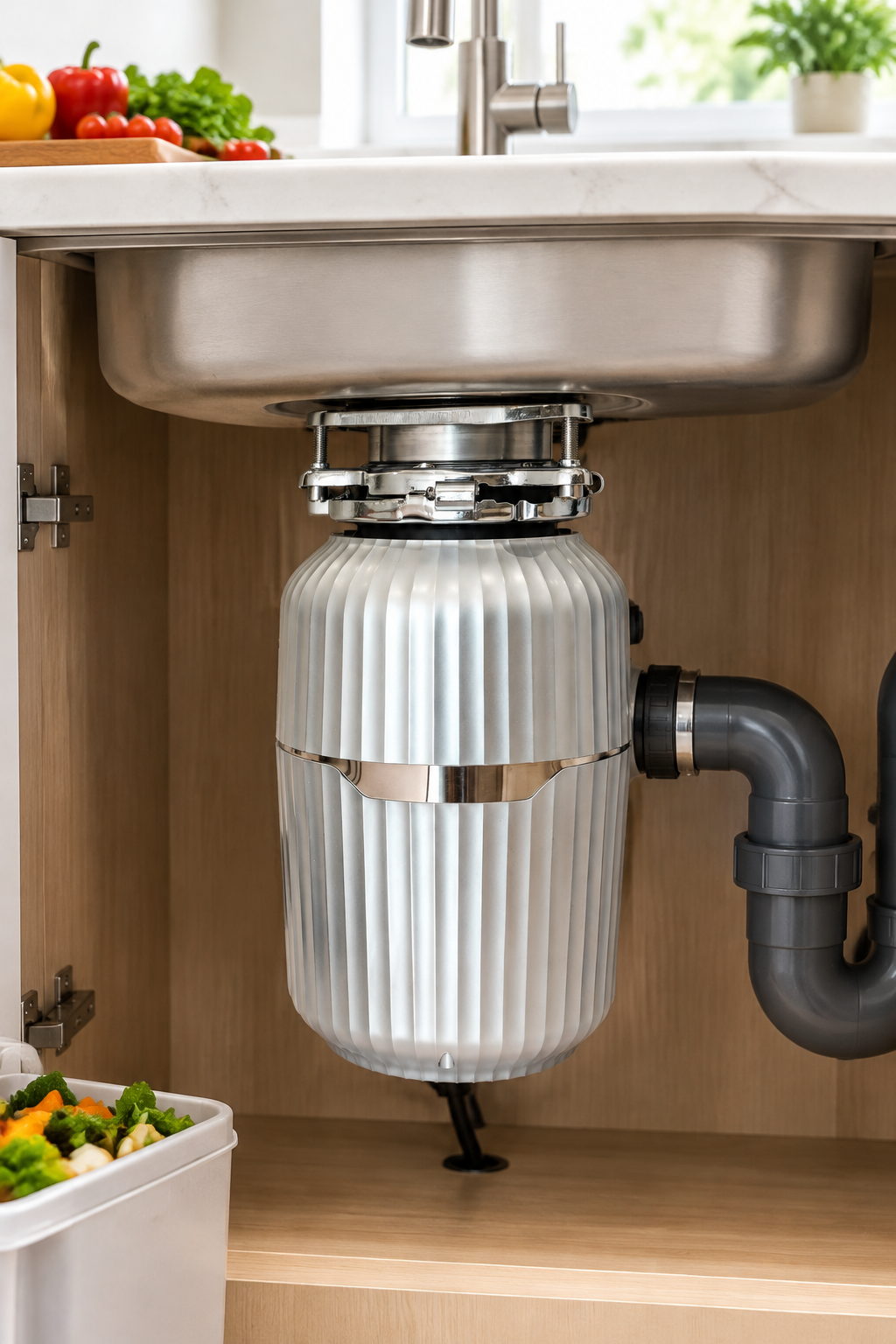
BLDC-based units tend to run quieter because the motor itself generates less mechanical friction. The PCD-1200TS is rated at 45dB, which is roughly comparable to a quiet conversation or a running refrigerator. For apartments, open-concept kitchens, or households with early sleepers, this is a meaningful comparison point that rarely gets the attention wattage does.
If noise matters to your household, ask for a dB rating specifically. Marketing copy that only mentions "quiet operation" without a number isn't giving you anything to compare.
Comparing Core Specifications at a Glance
When evaluating disposer options side by side, a short spec table makes the differences concrete rather than abstract.
| Specification | PCD-1200TS Detail |
|---|---|
| Power | 1200W |
| Motor Type | Brushless DC (BLDC) |
| No-load RPM | 1500 |
| Load RPM | 3000 |
| Grinding System | 2-Stage Grind |
| Grinding Capacity | 1300ml |
| Noise Level | 45dB |
| Control Options | Air switch / customized remote control |
| Net Weight | 5.5kg |
These figures, drawn from the manufacturer's published specifications, give a reference point for anyone comparing multiple models rather than relying on vague descriptions like "heavy duty" or "commercial grade."
Control Options: Air Switch vs Remote
How you turn the unit on matters more than people expect. Traditional wall-mounted switches require installing a separate button near the sink, often involving extra wiring.
Air switches solve this by using a sealed pneumatic button on the counter, connected to the disposer via a thin air tube rather than electrical wiring, which keeps water away from live connections. The PCD-1200TS supports both an air switch and a customized remote control, giving installers flexibility depending on counter layout or client preference. For kitchen renovators juggling multiple fixtures, having both options available simplifies planning instead of locking into one control method before installation.
Sizing and Installation Considerations
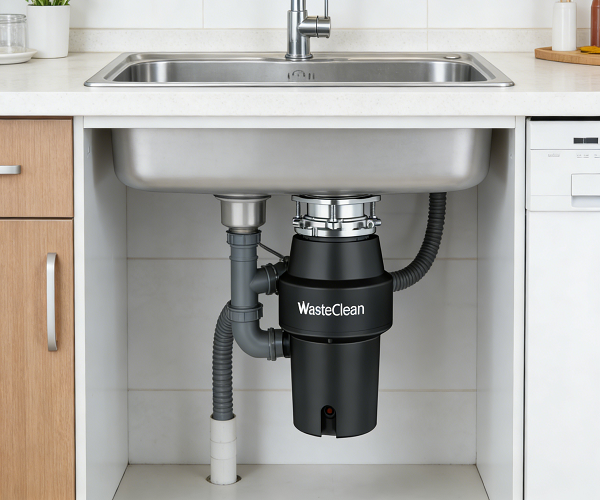
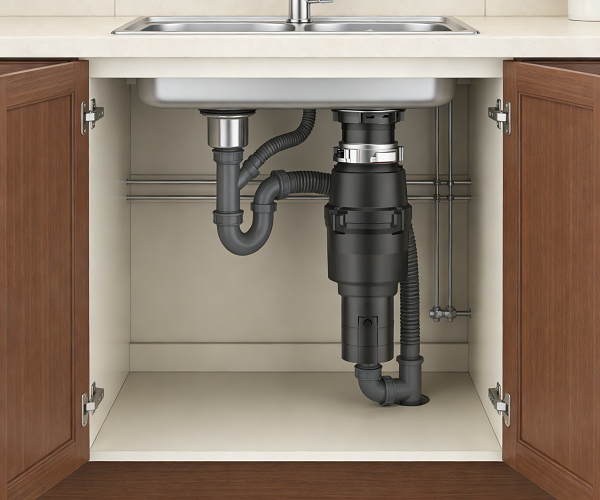
Before committing to any unit, measure the under-sink cabinet space. A disposer that's too tall or wide can conflict with plumbing, especially in kitchens with garbage disposals retrofitted into older cabinetry.
The PCD-1200TS measures 165 x 165 x 300mm and weighs 5.5kg net, figures worth checking against your existing cabinet clearance before ordering. Here's a quick mental checklist for installation planning:
- Confirm vertical clearance beneath the sink basin, accounting for the mounting assembly.
- Check that existing plumbing P-traps align with the disposer's outlet height.
- Verify your electrical setup matches the unit's voltage and plug requirements for your region.
- Decide between air switch and remote control based on counter space and wiring access.
Skipping this step is one of the most common reasons installations get delayed or require return shipping.
Who Actually Needs This Level of Power
Not every household needs a 1200W disposer. A single person who rarely cooks might be fine with a smaller, lower-wattage unit. But families who cook daily, process fibrous vegetable scraps, or deal with bones from meal prep benefit from the added shredding force and jam resistance that higher-powered BLDC units provide.
Residential kitchens handling regular organic waste disposal, and households upgrading toward smarter home kitchen setups, represent the typical use cases where this category of disposer earns its keep. It's less about bragging rights and more about matching the tool to how often, and how hard, your kitchen actually works.
Frequently Asked Questions
Does a higher wattage always mean a stronger disposer?
Not necessarily. Wattage indicates power draw, but motor type, RPM under load, and grinding stage design determine actual shredding performance. A well-designed BLDC motor at 1200W can outperform a poorly matched higher-wattage induction motor.
Will anti-jam reverse rotation damage the motor over time?
Based on the manufacturer's design intent, the reverse function is built into normal operating logic rather than being an emergency workaround, so it's designed to run as part of standard use rather than causing added wear.
Is a 45dB noise rating actually quiet?
For context, 45dB sits near the level of a quiet office or a running refrigerator, noticeably quieter than many older disposer models that run closer to 70-80dB under load.
Can I switch between air switch and remote control after installation?
This depends on the specific wiring setup chosen during installation. Confirming compatibility with your installer before mounting avoids rework later.
Choosing a Disposer That Matches Real Kitchen Demands
Picking between disposer models shouldn't come down to whichever has the biggest number on the box. The combination of BLDC motor efficiency, two-stage grinding, anti-jam reversal, and a verified noise rating gives a clearer picture of real-world performance than wattage alone ever could.
For buyers and distributors sourcing at scale, manufacturers like us at Foshan ZAL Intelligent Home Appliance Co., Ltd. build this category of unit specifically around OEM and ODM flexibility, offering voltage and plug customization for different regional markets alongside the core mechanical design. Whether you're furnishing a single kitchen renovation or sourcing inventory for distribution, understanding what sits behind the spec sheet, motor type, grinding stages, RPM behavior under load, is what separates a genuinely powerful food waste disposer from one that just sounds powerful in the listing copy.
Related News
SUBSCRIBE
INQUIRY