
The Engineering Mechanics of 0.75HP PMDC Motors in Kitchen Waste Disposers
Most homeowners evaluate kitchen waste disposers based entirely on superficial metrics. They assume higher wattage automatically translates to fewer sink clogs. The reality of processing fibrous vegetable peels, alongside dense chicken bones, relies on a delicate balance of torque and chamber geometry.
Engineers understand that a high-performance system requires continuous kinetic transfer. For us, designing and manufacturing hundreds of thousands of units for global brands, means analyzing microscopic mechanical failures. Modern disposal architectures depend heavily on permanent magnet direct current designs.
Why Torque Outperforms Raw Horsepower in Bone Processing
A common physical challenge in waste management is initial impact resistance. When hard food scraps enter the grinding chamber, the electric motor faces an immediate deceleration spike. Standard alternating current motors often stall during this critical microsecond.
The integration of a 0.75HP 560W PMDC motor shifts the performance curve entirely. Permanent magnets maintain a constant and unwavering magnetic field. This allows the system to generate maximum torque precisely when the grinding plate encounters dense organic matter.
Direct current architectures bypass the delayed induction phase inherent in older models. This rapid electrical response translates directly into kinetic authority. The user perceives this continuous power as a steady mechanical hum, even when dropping rigid materials into the sink flange.
Instead of relying solely on sheer mass, the system uses targeted rotational force. The no-load speed sits comfortably at 3800 RPM. When processing thick materials, the load speed drops to 2500 RPM, maintaining enough rotational momentum to prevent mechanical jamming.
The Physical Logic Behind 2-Stage Grinding Architecture
Raw torque means nothing if the grinding chamber cannot effectively shear the material. Single-stage systems merely smash food against the outer stationary ring. This often leaves large fibrous strands intact, which inevitably entangle the household plumbing downstream.
Advanced multi-stage engineering alters the physical breakdown process fundamentally. The initial stage shatters rigid structures, like pork or chicken bones, into coarse fragments. The secondary stage utilizes precision-machined stainless steel teeth to liquefy these heavy particles.
This mechanical sequence ensures that organic waste passes through municipal water systems without accumulating in pipe bends. Here are the core structural elements involved:
- High-density stainless steel mounting flanges
- Impact-resistant metal cutter heads
- Engineered internal splash guards
Managing Acoustic Output at High Rotational Speeds
High-speed kinetic grinding inherently generates substantial vibrational energy. Many consumers associate powerful domestic appliances with unbearable noise levels. However, sound generation in these specific devices originates primarily from structural resonance, rather than the electric motor itself.
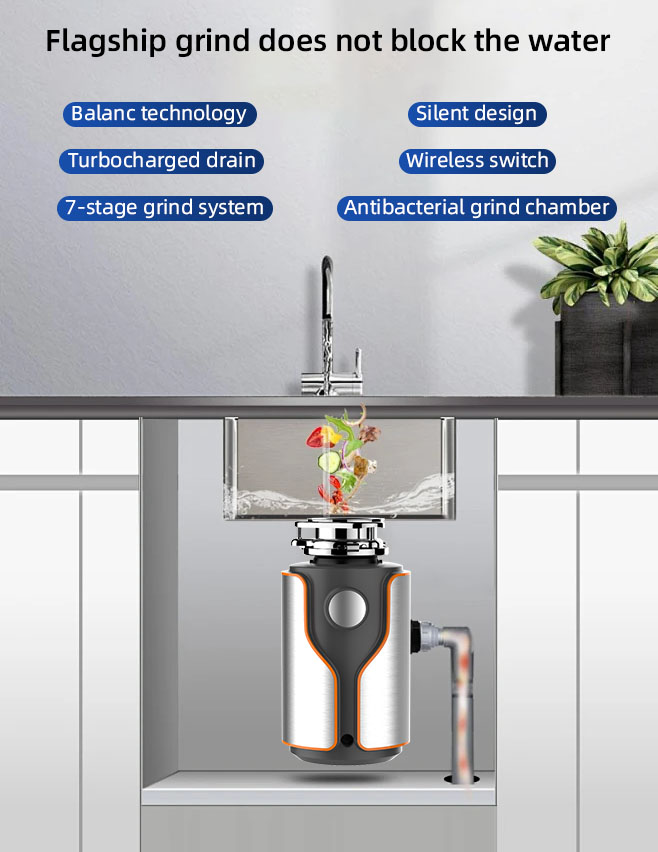
Acoustic isolation requires interrupting the mechanical transfer of vibration directly at the source. Non-jitter balancing technology ensures the rotating cutter head remains perfectly aligned on its axis. This prevents the microscopic eccentricities that typically cause heavy knocking sounds.
Coupled with dedicated sound insulation materials, this strict structural alignment effectively caps the acoustic output at 61dB. Users experience a low directional hum rather than a disruptive mechanical roar. The psychological perception of appliance reliability often correlates directly with this acoustic restraint.
Bacteriostatic Chambers and Fluid Dynamics
Residual organic matter trapped in the lower chamber creates an ideal breeding ground for bacterial cultures. Over time, these undisturbed bacterial colonies generate volatile organic compounds. This biological process remains the root cause of persistent odors commonly associated with sink drains.
Engineers address this biological challenge through advanced material science and fluid dynamics. The internal grinding chamber utilizes specific bacteriostatic properties to inhibit microbial reproduction. This passive defense mechanism maintains a highly hygienic environment between active grinding sessions.
Water flow plays an equally vital role in internal self-cleaning routines. Turbocharged drainage geometry accelerates the exit velocity of the liquefied waste. This high-pressure fluid evacuation scours the internal walls, forcing heavy particulate matter straight through the connected dishwasher interface.
Frequently Asked Questions on Disposer Engineering
Does a higher RPM always guarantee a finer grind?
Speed alone cannot compensate for poor cutter geometry. An excessive RPM without sufficient torque simply bounces hard materials around the chamber. Effective systems balance a 2500 RPM load speed with aggressive 2-stage shearing teeth.
Why do some units jam when processing fibrous vegetables?
Vegetable fibers possess incredibly high tensile strength. They tend to wrap around rotating components rather than fracturing upon initial impact. PMDC motors provide the instant torque required to snap these fibers before they entangle the central shaft.
Are continuous feed systems prone to premature motor wear?
Thermal accumulation dictates motor lifespan in continuous heavy applications. The 5.6kg net weight of our referenced system heavily features heat-dissipating metallic structures. This thermal management allows the 560W coil to process a full 1200ml chamber without triggering the overload reset switch.
Hardware Compatibility and Structural Footprint
Understanding the exact hardware dimensions helps professionals in evaluating immediate sink compatibility. A compact physical footprint does not necessarily require a compromise in processing volume.
| Engineering Metric | Technical Specification |
|---|---|
| Motor Configuration | 0.75HP 560W PMDC |
| Internal Grinding Capacity | 1200ml Bacteriostatic Chamber |
| Rotational Speed | 3800 RPM (No-load) / 2500 RPM (Load) |
| Maximum Acoustic Output | 61dB with Non-jitter Tech |
| Physical Dimensions | 184 x 184 x 350 mm |
Selecting reliable hardware demands a thorough evaluation of internal physics. Surface-level specifications often obscure the real engineering challenges of organic matter breakdown. By analyzing the synergy between PMDC torque and multi-stage shearing, users can make highly informed architectural decisions.
Properly engineered systems eliminate the persistent anxiety of structural plumbing failures. They transform a messy household chore into a seamless mechanical process. Investing in structurally balanced heavy-duty kitchen waste disposers ultimately secures long-term kitchen hygiene, alongside uncompromised municipal drainage efficiency.
Related News
SUBSCRIBE
INQUIRY