
How a Heavy Duty Kitchen Waste Disposer Stops Persistent Drain Jams
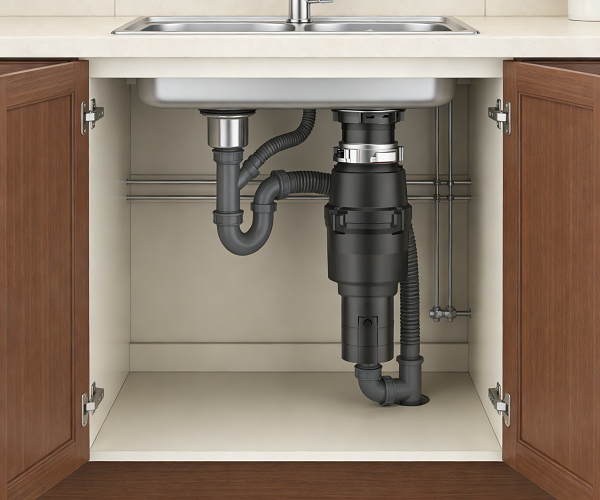
Kitchen drains often back up when ordinary grinders fail to pulverize fibrous scraps. Celery strings and potato peels wrap around standard impellers. This instantly restricts water flow and forces you to reach for a plunger. A heavy duty kitchen waste disposer attacks this specific mechanical failure. Upgrading your sink hardware eliminates the weekly frustration of standing water.
Why do standard disposals jam on fibrous vegetables?
Standard models rely on low-torque motors and galvanized steel grind rings. When you feed them artichoke leaves or corn husks, the fibers slip past the blunt lugs. These intact strings then weave themselves around the motor shaft. They create a tight biological rope that stalls the rotation mechanism completely.
How much horsepower defines a high-torque unit?
Motor power dictates whether food waste shears or simply spins. Standard units typically operate at fractional power levels, struggling with dense materials. A heavy duty kitchen waste disposer requires at least 0.75 HP, often reaching 1.0 HP. This higher torque output snaps poultry bones instantly instead of grinding them slowly.
Torque prevents the motor from overheating during extended dinner prep sessions. A robust motor pushes through fibrous resistance without dropping its rotational RPM. This sustained speed ensures waste is evacuated into the drain lines rapidly.
What materials handle chicken bones without dulling?
Grinding components dictate the lifespan of your kitchen equipment. If you process hard food waste daily, the internal chamber takes massive impact force. To maintain cutting efficiency over thousands of meals, look for these specific materials:
- Stainless steel impellers to resist acid corrosion.
- Cold-rolled steel grind rings to maintain edge sharpness.
- Cast alloy mounting assemblies to absorb shock vibration.
Galvanized steel components will rust and blunt within two years of daily exposure to acidic citrus peels. Upgrading to dense, non-corrosive metals guarantees the shear rings will not deteriorate.
How to select the right grind stage for your plumbing?
Grind stages determine the final particle size entering your pipes. Single-stage systems chop waste once, leaving chunks that can settle in older cast-iron plumbing. Multi-stage grinding forces waste through concentric shear rings. It reduces ribs and fruit pits into a fine liquid paste.
This liquefied output prevents sludge accumulation in the P-trap. Fine particles travel freely through municipal sewer lines without forming bottlenecks. You spend less money on chemical drain cleaners and mechanical snaking services.
| Specification | Standard Disposer | Heavy Duty Disposer |
|---|---|---|
| Motor Power | 0.33 HP - 0.5 HP | 0.75 HP - 1.0 HP |
| Grind Components | Galvanized Steel | Stainless Steel |
| Grinding Stages | Single Stage | 2-Stage or 3-Stage |
| Noise Insulation | Basic Foam | Multi-layer Acoustic Shell |
How much does replacing a burned-out motor cost?
Replacing a stalled kitchen disposal is an expensive weekend project. A basic replacement unit costs money, but hiring a licensed plumber adds steep labor fees. Burnouts happen frequently when weak motors struggle against dense vegetable matter.
Investing upfront in a heavy duty kitchen waste disposer prevents this recurring replacement cycle. The initial hardware cost offsets the future plumbing bills and wasted weekend hours.
Can a continuous feed unit manage large household prep?
Batch feed models require you to load waste and turn a stopper. This slows down cleanup when processing large volumes of potato peels. Continuous feed systems allow you to push waste through the rubber baffle while the motor runs.
A heavy duty kitchen waste disposer paired with continuous feed handles massive scraps without pausing. Just keep the cold water running to flush the paste away. You clear the cutting board instantly without interrupting your cooking workflow.
How to avoid noise complaints with high-torque motors?
One major drawback of a high-torque motor is the acoustic output. A 1.0 HP motor grinding beef bones generates significant vibration. The grinding chamber acts like a drum, amplifying the mechanical noise through the sink basin.
To mitigate this kitchen racket, modern units employ targeted acoustic engineering:
- Closed-cell foam insulation surrounding the motor housing.
- Anti-vibration rubber tailpipe connections.
- Quiet-collar sink baffles that block sound from escaping the drain.
These isolation methods decouple the vibrating motor from the resonant stainless steel sink.
What maintenance keeps the grind chamber smelling fresh?
Food residue trapped beneath the rubber splash baffle creates foul kitchen odors. Even premium hardware needs regular cleaning to remain sanitary. Citrus peels provide a temporary aromatic fix but do not remove bacterial biofilm.
For actual sanitation, follow this exact mechanical cleaning routine monthly:
- Fill the sink with ice cubes and one cup of rock salt.
- Run the cold water at a slow trickle.
- Turn on the unit to let the ice scour the grind ring.
Why do OEM manufacturers focus on customized electrical standards?
Different regions have distinct electrical grid requirements and sink mounting depths. A motor wired for 110V will instantly fail on a 220V circuit. Plugs, voltage, and frequency must match local residential codes perfectly.
For us, building large volumes annually means adapting components for diverse international specifications. Flexibility in manufacturing allows distributors to stock models that won't short-circuit local housing grids. This ensures seamless integration regardless of the geographical market.
Will high-torque grinders damage a residential septic tank?
Many rural homeowners fear that food scraps will disrupt septic bacterial balance. Coarse chunks from a cheap grinder take months to decompose, causing tank sludge to rise rapidly.
A high-torque unit equipped with three-stage grinding produces an easily digestible slurry. This microscopic waste actually feeds the bacteria without clogging the drainage field. Always verify your tank capacity before adding any food waste load.
How does cold water affect the grinding process?
People often use hot water under the false assumption it melts fats better. Hot water actually turns grease into a liquid that coats your PVC pipes. When this liquid grease travels further down, it cools and hardens into massive blockages.
Always run your grinder with a strong flow of cold water. Cold water keeps fats solid, allowing the stainless steel impellers to shatter them. This simple temperature adjustment saves your plumbing from severe lipid accumulation.
Why does the reset button trip during operation?
Most entry-level grinders spin the impellers in a single continuous direction. If a tough piece of bone wedges at a harsh angle, the motor stalls out immediately. The user then has to manually dislodge the rotor.
Advanced models feature a microprocessor that detects rotational resistance on the drive shaft. The internal mechanism will instantly reverse its spin direction to dislodge the jam. This mechanical back-and-forth action continues until the stubborn obstacle is pulverized.
When should you upgrade your sink mounting flange?
A standard aluminum flange works fine for lightweight fractional-horsepower motors. When you upgrade to a high-torque system, the rotational vibration increases dramatically. The torque reaction upon startup can twist a thin aluminum flange loose.
A true heavy duty kitchen waste disposer requires a solid stainless steel mounting assembly. It must feature a rigid three-bolt locking mechanism to handle the torque. This unyielding connection stops microscopic leaks from forming under the sink basin.
Related News
SUBSCRIBE
INQUIRY