
High-Power Food Waste Disposers: What Actually Separates Them From Standard Units
Anyone who has stood over a clogged sink at 7 a.m., waiting for a slow motor to grind through a potato peel, understands why high-power food waste disposers get searched for by name. Power is not a vanity spec here. It is the difference between a disposer that chews through fibrous scraps in seconds and one that stalls, hums, and eventually trips a breaker. This guide looks at what "high-power" means mechanically, where the real performance gains come from, and how to judge whether a unit's wattage claims translate into actual kitchen performance.
Why Low-Power Disposers Struggle With Everyday Waste
Most kitchen waste is not soft. Celery strings, corn husks, and bone fragments resist shredding, and a weak motor simply cannot maintain torque under that resistance. The result is jamming, overheating, or a motor that burns out well before its expected lifespan.
This is a torque problem more than a speed problem. A motor can spin fast under no load and still fail the moment it meets real resistance, because load changes the dynamics entirely. That gap between no-load and load performance is exactly where cheaper disposers reveal their limits.
The Role of BLDC Motors in Modern Disposers
Brushless DC (BLDC) motors have become the preferred choice for higher-performance disposers, replacing the older induction and brushed motor designs still common in budget units. There is no physical brush contact wearing down over time, which is one reason BLDC-based units tend to run quieter and last longer under repeated use.
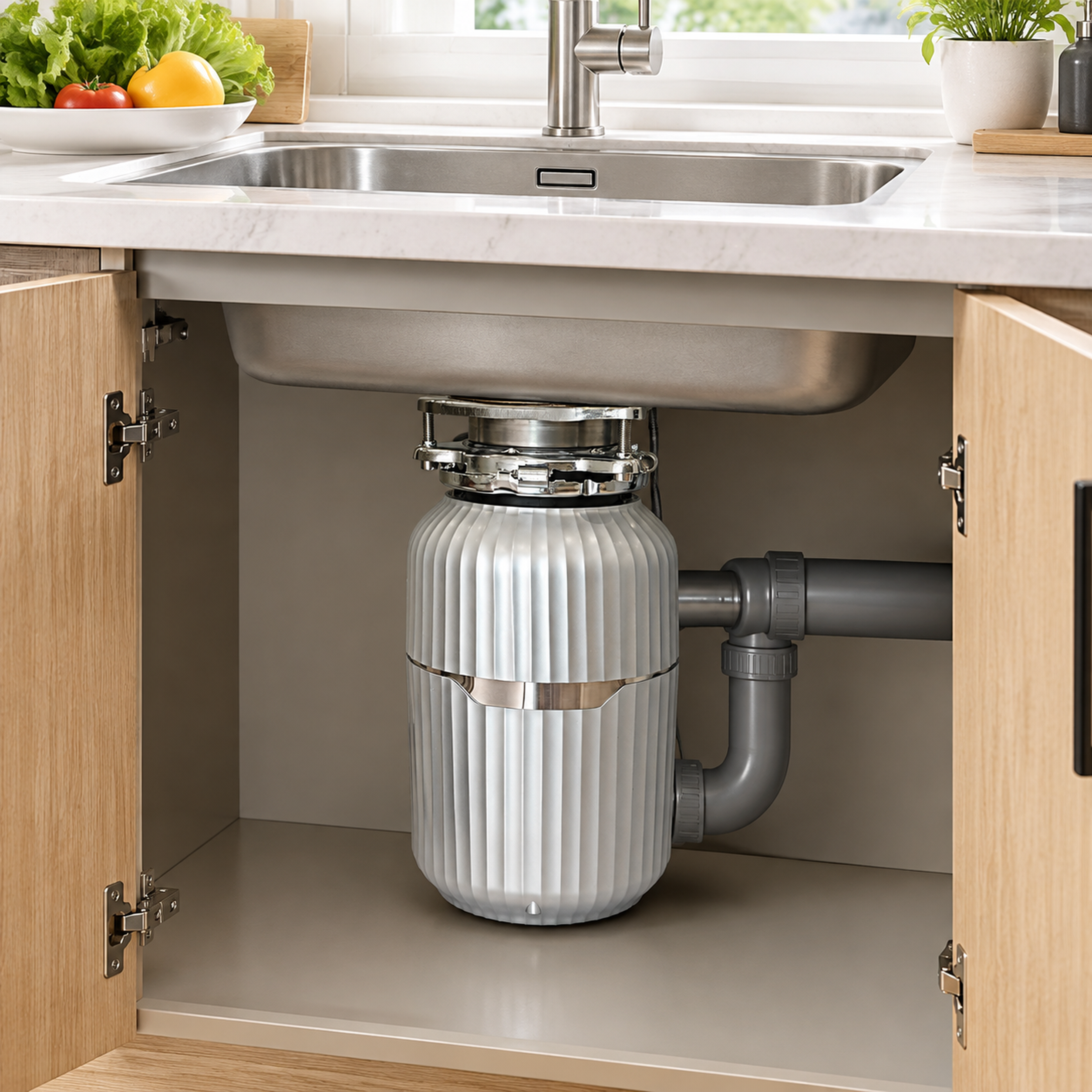
A disposer like the BLDC Motor 1200W Household Sink Food Waste Disposer illustrates this shift well. According to the product specifications, it runs at 1500 RPM with no load and reaches 3000 RPM under load, a jump that reflects a motor built to respond to resistance instead of stalling against it. Rated at 1200W, it operates on a 50Hz supply and carries a 2-stage grinding system designed for progressively breaking down waste rather than relying on a single cutting pass.
Anti-Jam Design: Solving the Most Common Disposer Complaint
Jamming is the single most frequent complaint tied to food waste disposers, and it usually traces back to one of two causes: a motor without enough reserve torque, or a grinding chamber with no mechanism to clear debris that catches between the blades.
Automatic forward and reverse rotation addresses the second cause directly. When resistance builds, the motor reverses direction briefly to dislodge whatever is caught, then resumes forward grinding. The 1200W BLDC unit's specifications describe this anti-jam function working alongside intelligent grinding control that adjusts speed and shuts the unit down automatically once grinding is complete.
That shutdown behavior matters more than it might seem. A disposer left running after waste has already cleared wastes electricity and adds unnecessary wear to bearings and seals.
Reading a Disposer Spec Sheet Correctly
Manufacturers list a lot of numbers, and not all of them carry equal weight for daily use. Here is how the core specifications of a representative high-power unit break down:
| Specification | Value | What It Tells You |
|---|---|---|
| Motor type | Brushless DC (BLDC) | Lower wear, generally quieter than brushed motors |
| Power | 1200W | Higher reserve torque for fibrous or dense waste |
| No-load RPM | 1500 | Baseline spin speed with nothing being ground |
| Load RPM | 3000 | Speed under actual grinding resistance |
| Grinding system | 2-Stage Grind | Waste is broken down in sequential stages |
| Grinding capacity | 1300ml | Volume the chamber can process per cycle |
| Noise level | 45dB | Comparable to a quiet conversation |
| Net weight | 5.5kg | Heavier units often indicate more internal shielding |
Noise rating deserves particular attention. A 45dB rating sits close to the sound of a quiet library, which matters in open-plan kitchens where a loud disposer disrupts conversation at the dinner table. Weight is a quieter signal, too. Heavier units generally pack more insulation and a sturdier motor housing, both of which contribute to lower vibration and sound transfer through the sink basin.
Air Switch vs Remote Control: Choosing an Activation Method
Disposer activation methods have not changed much over the decades, but newer units are expanding the options. The 1200W BLDC model offers both an air switch and a customized remote control, and the right choice depends on kitchen layout and user preference.
- Air switch: A sealed, waterproof button installed on the counter, connected to the disposer by an air hose rather than electrical wiring. It avoids the risk of water near electrical switches entirely.
- Remote control: Useful in kitchens where counter space near the sink is limited, or where a secondary switch point is preferred, such as near a prep island.
- Dual control setup: Running both options together gives flexibility without requiring a rewire if preferences change later.
Neither method is objectively superior. The air switch has a long track record for safety and reliability, while a remote control offers placement freedom that some kitchen layouts genuinely need.
Grinding Capacity and Real Kitchen Volume
A 1300ml grinding capacity sounds abstract until it is translated into kitchen terms. That volume roughly matches the scraps generated from preparing a meal for a family of four, including vegetable trims, small bones, and coffee grounds. Households that batch-cook or frequently host larger meals should think about grinding capacity the same way they think about dishwasher basket size: undersized capacity means more frequent cycles, not necessarily more mess.
Capacity interacts with power in a way that is easy to overlook. A larger grinding chamber without sufficient motor torque just means more material sitting in the chamber waiting to be processed slowly. Capacity and power need to scale together, not independently.
Common Questions About High-Power Disposers
Does a higher wattage rating always mean better grinding performance?
Not by itself. Wattage indicates available power, but how that power is delivered under load, through motor type, grinding stages, and anti-jam control, determines actual grinding effectiveness.
Will a 1200W disposer increase electricity bills noticeably?
Disposers run for seconds to a few minutes per use, so the actual energy draw per session is small. Automatic shutdown features also help by preventing the motor from running idle after grinding finishes.
Is a BLDC motor harder to repair than a traditional one?
BLDC motors have fewer wearing parts since there are no brushes to replace, which generally reduces maintenance needs rather than increasing them.
Can these disposers handle bones and fibrous vegetables?
Product specifications for 2-stage grinding systems describe them as designed to progressively break down tougher waste, though extremely large bones are generally still discouraged across most disposer types.
Matching a Disposer to Your Kitchen's Actual Demands
Choosing between disposer models should start with honest usage patterns rather than the biggest number on the spec sheet. A household cooking simple meals a few times a week has different needs than one running a disposer multiple times daily with mixed food waste, including fibrous trimmings and small bones.
For buyers and distributors evaluating OEM or ODM sourcing, specification sheets like the one for the 1200W BLDC model offer a useful template: motor type, load RPM, grinding stages, noise rating, and physical dimensions together paint a far more complete picture than wattage alone. Foshan ZAL Intelligent Home Appliance Co., Ltd. has spent over 20 years manufacturing disposers across more than 30 models, and that range exists precisely because no single configuration fits every kitchen or every market's voltage and certification requirements.
Ultimately, the search for high-power food waste disposers should end with a unit matched to real cooking habits, not just a headline number. Torque under load, anti-jam response, grinding capacity, and noise control together determine whether a disposer earns its "high-power" label in daily use, or just on paper.
Related News
SUBSCRIBE
INQUIRY