
Engineering the Grind: Torque, Velocity, and Acoustic Balance in Household Garbage Disposals
Evaluating the mechanical efficacy of modern household garbage disposals requires looking past surface-level wattage figures. Consumers often encounter a landscape cluttered with ambiguous technical specifications and aggressive marketing claims. The core engineering challenge always lies in balancing rotational velocity with sustained kinetic energy.
The anatomy of these machines reveals a careful calibration of physical forces. Consumers must decipher how electrical current translates into kinetic shear force within a wet environment. A motor spinning rapidly in empty space behaves entirely differently when confronting fibrous organic matter.
The Disconnect Between Stated RPM and Actual Grinding Force
Many manufacturers prominently advertise exceptionally high revolutions per minute. A specific unit might boast 3500 RPM on a printed specification sheet. That number merely represents the motor spinning freely without any physical resistance. The true metric of mechanical capability emerges only under heavy load.
This is where the distinction between alternating current and permanent magnet direct current becomes highly visible. A 1HP 750W PMDC motor maintains a loaded speed of 2800 RPM during heavy processing. The 700 RPM drop represents the electrical torque being actively converted into physical shearing force. Less capable motors experience catastrophic speed drops under similar mechanical stress.
Multilayer Reduction Physics in Stainless Steel Chambers
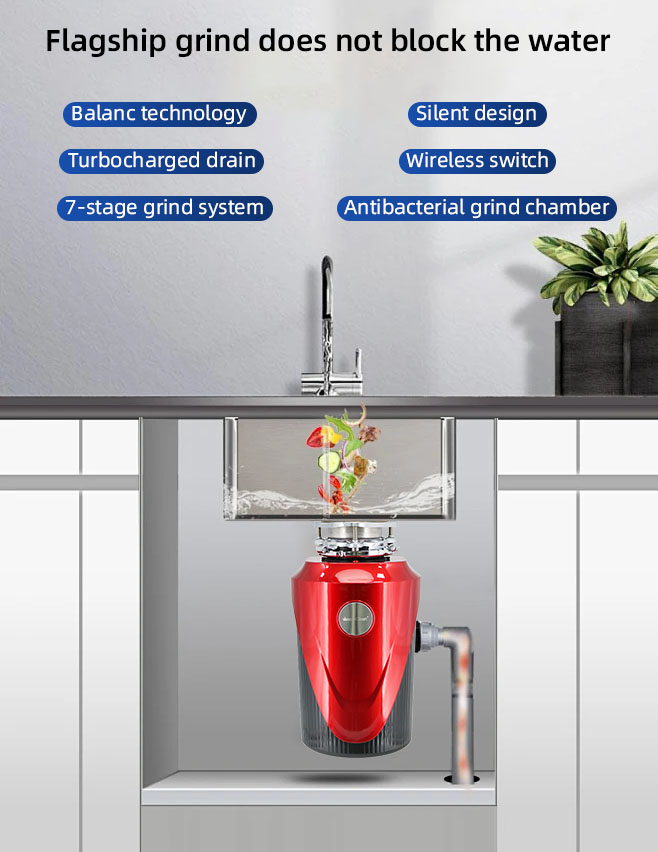
Food waste does not simply vanish through blunt force trauma inside the machine. Effective breakdown relies on a sequenced mechanical process known as multilayer grinding. Centrifugal force drives the organic material outward against a completely stationary stainless steel grind ring.
Internal impellers then strike the matter repeatedly, forcing the organic tissue through progressively smaller sheer gaps. Chamber volume directly impacts this centrifugal efficiency. A 1500ml grinding chamber allows sufficient spatial separation for particles to circulate freely before hitting the shear ring.
If a chamber geometry is too restrictive, the wet material binds together. This creates a thick organic paste that defies proper mechanical reduction. The resulting fine, uniform residue is exactly what prevents downstream pipe blockages in older residential plumbing.
Fluid Dynamics and Turbocharged Evacuation
Grinding food into microscopic particulate matter represents only the first half of the engineering equation. The subsequent challenge involves moving that dense slurry through residential plumbing architecture without causing gradual sediment buildup. A properly calibrated impeller disk acts as a rudimentary centrifugal water pump.
This localized pressure differential forces water down the drain pipe at significantly elevated velocities. The turbocharged drainage effect actively prevents heavier organic particles from settling in the trap. Effective evacuation heavily relies on a specific sequence of hydrodynamic events:
- Sufficient centrifugal water velocity generated by the base disk
- Uniform sub-millimeter particle sizing from the shear ring
- Immediate downward evacuation pressure clearing the primary chamber
If the evacuation flow remains too passive, fibrous residue slowly coats the pipe interior. This slow accumulation leads to the exact plumbing blockages the machine was originally purchased to prevent.
Vibration Mitigation at High Rotational Speeds
Harnessing 750 watts of direct current power inevitably generates significant kinetic energy. Left unchecked, this rogue energy translates into severe acoustic resonance and destructive structural vibration. Engineering a machine to operate reliably at 58dB requires manipulating the physical mass of the unit itself.
The 7kg net weight of the entire assembly acts as a foundational acoustic dampener. Beyond raw physical mass, structural stability relies entirely on dynamic balance technology. Every rotating internal component must be precisely counterweighted at the factory.
Even a single millimeter of asymmetry in the spinning disk causes exponential vibration amplification at 2800 RPM. Thick rubber splash shields serve a highly effective dual purpose. They act as a physical barrier for flying debris while simultaneously absorbing upward sound wave propagation.
Technical Specifications Matrix
| Operating Parameter | Technical Specification | Primary Engineering Purpose |
|---|---|---|
| Motor Architecture | PMDC Motor | Sustains high torque under heavy organic loads |
| Power Output | 1HP (750W) | Provides necessary mechanical shearing force |
| Operating Noise | 58dB | Achieved via dynamic balancing and acoustic shielding |
| Loaded Velocity | 2800 RPM | Indicates actual cutting speed during operation |
| Chamber Volume | 1500ml | Maximizes centrifugal material distribution |
Addressing Common Technical Misconceptions
Does a higher wattage rating guarantee a finer organic grind?
Wattage measures raw electrical consumption, not necessarily mechanical output efficiency. A poorly aligned 1000W motor will perform worse than a precisely calibrated 750W system. The actual grind quality depends heavily on the machined shear gap tolerance between the spinning impellers and the stationary ring.
Why do some household garbage disposals jam despite having high RPM?
High free-spinning RPM means very little if the motor lacks the rotational torque to push through sudden resistance. When fibrous materials wrap around the cutter head, low-torque motors stall instantly. A heavy-duty PMDC motor pushes through this resistance by maintaining high torque even as RPM naturally decreases.
Production Consistency and Mechanical Tolerances
Developing reliable waste processing hardware requires rigorous alignment between theoretical engineering and daily kitchen realities. For us, managing an annual production capacity of over 200,000 units means standardizing these strict mechanical tolerances. It involves a continuous cycle of evaluating how different regional food diets impact motor strain.
The physical human interface matters just as much as internal mechanical torque. Whether utilizing a pneumatic air switch or a remote control module, the electrical activation mechanism must remain completely isolated from the water flow. This ensures absolute safety in a heavily saturated environment.
Navigating the technical landscape of modern kitchen appliances requires a firm understanding of basic mechanical physics. Torque, centrifugal fluid dynamics, and structural acoustics dictate the real-world utility of the equipment. When evaluating household garbage disposals, scrutinize the loaded performance metrics rather than the theoretical maximums. True engineering efficacy is found in the quiet, consistent reduction of complex organic matter under severe mechanical strain.
Related News
SUBSCRIBE
INQUIRY